


If you've ever opened Instagram, LinkedIn, or Facebook and thought, "What am I supposed to post today?" you're not alone.
For many small business owners, content creation becomes another task added to an already full schedule. Between serving clients, managing operations, responding to emails, and keeping the business running, marketing often becomes reactive instead of intentional. As a result, content gets created at the last minute or not at all.
The good news is that creating consistent content doesn't require spending hours every day online. In fact, dedicating one afternoon each month to planning your content can save you time, reduce decision fatigue, and help your marketing support your business goals more effectively.
A simple content plan gives you direction, allowing you to spend less time wondering what to post and more time engaging with your audience.
Begin with Your Business Calendar
Before brainstorming content ideas, look at what's happening in your business over the next month.
Your marketing should reflect what your business is already doing. Instead of creating content just to stay active on social media, plan around the moments that already matter to your business.
- Are you launching a new product or service?
- Do you have a promotion or seasonal offer coming up?
- Are you attending a networking event, conference, or community event?
- Are there holidays or industry observances relevant to your audience?
- Is there a customer success story, business milestone, or behind-the-scenes project you can share?
When you begin with your calendar, your content naturally becomes more relevant and purposeful. Rather than scrambling for ideas each day, you'll already know what conversations you want to have throughout the month.
Planning this way also ensures your marketing supports your business objectives instead of competing with them.
Turn One Idea into Multiple Pieces of Content
One of the most common misconceptions about content planning is believing you need thirty completely different ideas every month.
You don't.
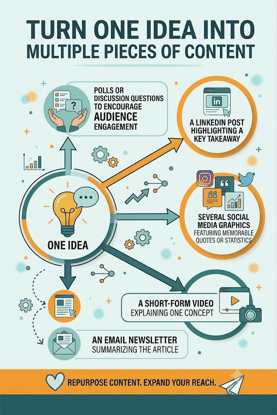
Start with one substantial piece of content—perhaps a blog, article, newsletter, podcast episode, or video that explores a topic important to your audience. From there, use the central idea to create content across your other digital platforms.
For example, one blog article can become:
- A LinkedIn post highlighting a key takeaway
- Several social media graphics featuring memorable quotes or statistics
- A short-form video explaining one concept
- An email newsletter summarizing the article
- Polls or discussion questions to encourage audience engagement
Not everyone consumes content the same way. Some people enjoy reading, while others prefer watching videos or scrolling through quick tips on social media. Repurposing your content allows you to reach your audience where they already spend their time while reinforcing your message across multiple channels.
Instead of creating something new every day, you're extending the life and value of one strong idea.
Create a Content Rhythm You Can Sustain
Consistency doesn't require posting every day. It requires having a system.
One of the easiest ways to simplify content planning is to assign recurring themes or topics to specific days of the week. Having a predictable rhythm makes brainstorming easier because you're never starting with a blank page.
Your schedule might look something like this:
- Monday: Marketing Tip Monday
- Wednesday: Wellness Wednesday
- Thursday: Behind the Business
- Saturday: Small Business Saturday
These recurring themes provide enough structure to guide your planning while giving you flexibility to talk about different topics each week.
It's equally helpful to batch your work by task instead of trying to create everything at once.
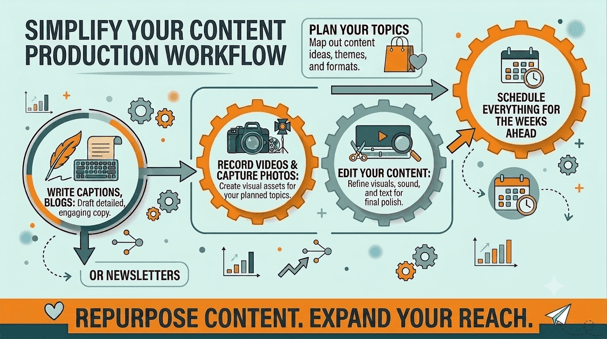
During your planning afternoon, consider breaking your workflow into simple stages:
- Plan your topics.
- Record videos or capture photos.
- Write captions, blogs, or newsletters.
- Edit your content.
- Schedule everything for the weeks ahead.
Completing similar tasks together is often more efficient than constantly switching between planning, creating, editing, and publishing.
More importantly, it helps marketing become part of your business routine instead of something that only happens when you have extra time.
Closing Thoughts
Planning thirty days of content isn't about filling every square on a content calendar. It's about creating a simple system that helps your marketing remain consistent without becoming overwhelming.
When you begin with your business calendar, build around one core idea, and establish a content rhythm that works for your schedule, you'll spend less time reacting and more time communicating with intention.
Your audience doesn't need more content. They need consistent, valuable content that reflects your expertise and supports the work your business is already doing.
Sometimes, all it takes is one afternoon to make the next thirty days feel a whole lot more manageable.